September 2026 Psychology subject update
Hi everyone,
Welcome back to a new academic year! I hope those of you who are returning from a holiday have had some quality rest and relaxation, and that you are looking forward to working with your students in the year ahead. This month's update has news from the British Psychological Society in addition to the usual key dates, resource and training news, as well as signposts to key support on results and post-results services.
As ever, please don't hesitate to get in touch if I might be able to help with any aspect of your teaching - follow the link below to the bottom of the page to book a Teams call with me or to get in touch via email.
Best wishes,
Tim Lawrence
Psychology Subject Advisor
This update includes:
- Key dates
- An update from the BPS: the British Psychological Society's committee for psychology education in schools and colleges has news for teachers and students
- Results support: key information on post-results services and other sources of support.
- Exam feedback surveys: a final chance to share your views on the May/June series papers if you haven't yet done so!
- Training and professional development: 'all set...' events in September and exam feedback training in November.
- Examiner reports available: a recommendation to make use of these resources to inform planning and teaching.
- FAQs from psychology teachers
| Date | Activity |
|---|---|
| 21 September | GCSE Psychology 'All Set for 2026-27' training 4pm |
| 23 September | IAL Psychology 'All Set for 2026-27' training 12pm |
| 23 September | A Level Psychology 'All Set for 2026-27' training 4pm |
| 24 September | Deadline for Review of Marking service |
| 16 October | Entry deadline for IAL Psychology January 2027 series |
| 10 November | A Level Psychology Exam Insights training* |
| 18 November | GCSE Psychology Exam Insights training |
| 11 December | Deadline for Access to Scripts |
*Exam Insights training for IAL Psychology will be available around this time as a pre-recorded event.
Final exam timetables for the summer 2027 exam series are available on our webpage linked below.

The British Psychological Society's Division of Academics, Researchers and Teachers in Psychology (DART-P) promotes the professional interests of psychologists who teach and/or conduct research, whether in a university, school, college or any other academic environment.
The Standing Committee on Psychology Education in Schools and Colleges (SCoPESC) is a vital part of DART-P and is the voice of the pre-tertiary sector within psychology education.
Members are keen to encourage more teachers and A Level students to join the BPS (students' e-subscriptions give them access to The Psychologist magazine and careers support), and for teachers with BPS membership to join SCoPESC.
Amongst other projects they are working to extend the excellent Teachers' Toolkit - a collection of free resources to support psychology teaching in schools. A new email address DARTPTeachersToolkit@bps.org.uk has been set up to facilitate the sharing of teaching resources.
For more information see SCoPESC Chair Jake Eagleton-Mitchell's introductory article below!
SCoPESC: Collaboratively Shaping the Future of Psychology Education in Schools and Colleges
Psychology is playing an increasingly visible role in education. Whether it’s supporting student wellbeing, helping us understand behaviour, or informing approaches to teaching and learning, psychological science is now part of everyday school and college life in a way it perhaps never was before.
As the subject continues to grow, so does the need for clear, reliable and practical support for teachers. This isn’t just about psychology specialists—it’s about anyone using psychological ideas in the classroom, often without even realising it.
The British Psychological Society’s Standing Committee on Psychology Education in Schools and Colleges (SCoPESC) has been set up to help meet that need. As part of the BPS Division of Academics, Researchers and Teachers in Psychology (DARTP), the committee focuses on strengthening psychology education across all settings.
I would like to introduce myself. I am Jake Eagleton-Mitchell, CPsychol, AFBPsS, a secondary school Psychology Teacher and Head of Social Science. My work in the classroom very much shapes my thinking and my championing of a BPS that supports its teachers and schools. I know firsthand the pressures teachers are under, and how valuable it is to have guidance, research and resources that are not only accurate but also usable.
Our Purpose
At its heart, SCoPESC is here to support teachers.
That includes:
• Psychology teachers in schools and colleges
• Non-specialist teachers using psychological ideas in their subjects
• Educators drawing on psychology to support learning, behaviour and wellbeing
A lot of what we’re trying to do is bridge a gap. Psychological research is rich and fascinating—but it doesn’t always land in a way that feels immediately useful in the classroom. Our aim is to help translate that research into something practical, realistic and grounded in day-to-day teaching and school leadership.
A National Voice for Psychology Education
One of the things we’re working towards is a stronger, more joined-up voice for psychology education across the UK.
That means working across England, Scotland, Wales and Northern Ireland to support consistent access to high-quality, evidence-informed practice. It also means building stronger relationships with awarding organisations and exam boards so that psychology is supported not just as a qualification, but as a discipline that can genuinely enhance teaching and learning more widely.
We’re also keen to see psychology better recognised within education policy. As a scientific discipline—with strong empirical foundations, experimental methods and a clear evidence base—it has a lot to offer beyond the exam classroom. In the longer term, we’d like to see psychology sitting more confidently alongside the core sciences in how it is understood and valued within education systems.
What We Are Developing
A big part of SCoPESC’s work is developing practical, evidence-informed resources in collaboration with teachers, academics and psychologists across the BPS.
At the moment, we’re focusing on areas that teachers tell us matter most:
• Research Methods
• Mental health and wellbeing in education
• Inclusion and neurodiversity
• Behaviour and behaviour change
• Digital wellbeing and phone-free school environments
• Cross-curricular applications of psychology
• Pedagogy
• Careers
Everything we produce is designed to be independent of exam boards but helps upskill and develop psychology applications and understanding for those who are most in need. Our resources and publications are reviewed by relevant BPS specialist divisions, which helps ensure the content is both accurate and up to date. Just as importantly, we try to keep it accessible—something that can be picked up and used without wading through pages of theory.
We’re also beginning to develop online workshops in partnership with universities, focusing on applied psychological skills and helping students engage more deeply with the subject beyond the specification.
Listening to Teachers: A Collaborative Approach
We’re actively speaking with psychology teachers across the UK to understand what’s working well, what isn’t, and where support is most needed. That includes teachers in very different contexts—because the reality of teaching psychology in a large sixth form college is very different from teaching it in a small school where it’s one of many responsibilities.
We’re also interested in how psychology is being used beyond the subject itself, and how the BPS can better support that wider application. Ultimately, we want a British Psychological Society that feels relevant to all educators, not just those working in traditional psychology pathways.
Over the coming months, SCoPESC will be undertaking a nationwide review of psychology education, reaching out to teachers, school leaders and training providers. Your voice is crucial in helping us build an accurate picture of the current landscape and ensure that the British Psychological Society continues to evolve as an inclusive and effective organisation for everyone working in education.
Working Across the Profession
SCoPESC doesn’t work in isolation. We’re fortunate to collaborate with awarding organisations, universities, teacher educators and professional bodies such as the Association for the Teaching of Psychology (ATP).
That collaboration really matters. It helps avoid duplication, strengthens consistency, and ensures that teachers aren’t being overwhelmed with conflicting guidance or resources.
More importantly, it helps build a more connected approach to psychology education—one where different parts of the profession are working with, rather than alongside, each other.
Get Involved
We’re currently developing the BPS Teacher Toolkit, which is a growing collection of free, evidence-informed classroom resources.
We’re always keen to hear from teachers who have ideas, activities or articles they’d like to share. If you’ve created something that works well in your classroom, there’s a good chance it will work for others too.
Submissions can be sent to:
DARTPTeachersToolkit@bps.org.uk
All contributions are reviewed for quality and accuracy before being published. Our editorial team will reach out with questions if required.
Join the Community
BPS membership offers access to CPD at reduced rates, networking opportunities, The Psychologist magazine, and a range of professional resources. Guidance is available to help individuals choose the most appropriate membership option.
For A-level students, e-subscriptions at £18 per year provide access to psychology content, careers information and wider subject engagement. These can be particularly helpful when students are thinking about next steps after sixth form or college. It can also help schools achieve Gatsby Benchmarks in careers education.
Members of the BPS are also encouraged to consider getting involved with SCoPESC in future recruitment rounds. It’s a chance to contribute directly to shaping psychology education at a national level.
I look forward to supporting you and working with you to build a more inclusive and enriching BPS.
Jake Eagleton-Mitchell CPsychol, AFBPsS
Chair of SCoPESC and Head of Social Science
Teachers interested in services such as Review of Marking and Moderation, and Resultsplus and Access to Scxripts (both of which can be invaluable tools for improving teaching through analysis of exam performance) may find our results support page helpful now.
Written permission from students is required for both reviews of marking and access to scripts.
If you didn't get a chance to share your feedback on the May/June exam papers at the end of last term, the surveys below will remain open until 15 September and we will be conducting our final analysis of the feedback then. Thanks again to all the teachers who have already completed these - the information gathered is really valuable and will be carefully considered.
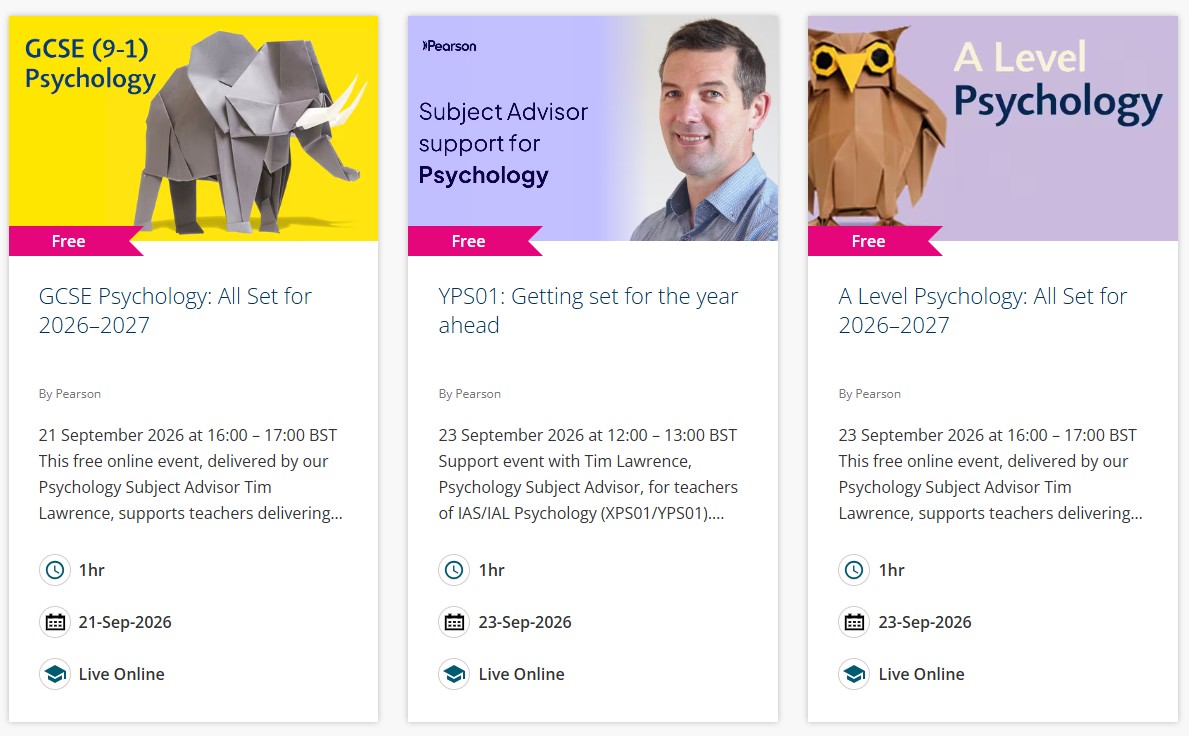
This September we will repeat the 'All set...' events that we ran in 2025. These are free, online training sessions consisting of a presentation of around 40 minutes focused on useful resources available on the website and reminders of key guidance around course delivery, followed by a Q&A. The aim is to get teachers ready for the year ahead, and last year feedback from experienced and new teachers was very positive. These sessions will not give detailed feedback on the May/June 2026 exam series (see below regarding that) but will cover recurring themes from recent examiner reports. The dates and tmes are:
- GCSE Psychology - Monday 21 September 16.00-17.00 UK time
- IAL Psychology - Wednesday 23 September 12.00-13.00 UK time
- UK A Level Psychology - Wednesday 23 September 16.00-17.00 UK time
At the time of writing these events are not yet open for booking but they will be shortly via the link below.
Live, free, online exam feedback events in November are now available for booking for A Level Psychology (on 10 November) and for GCSE Psychology (on 18 November). Pre-recorded exam feedback training for IAL Psychology will also be available around this time.
Follow the link below to find out more.
The link above will also show options to access recordings of past training content, including the following playlists:
We also provide centre-based training opportunities. If this is something you would like to explore, please visit our training page below.
The reports from our Principle Examiners on each of the May/June series exams are now available. These contain general feedback on what students generally did well, and on what they found challenging, as well as insights into each individual question. Example responses with the marks awarded and commentary make these reports particularly useful for teachers and students preparing for future exams. The most recent reports (along with the papers and mark schemes) are locked for teachers with Edexcel Online logins. If you teach at a Pearson Edexcel centre and don't currently have a login, your Exams Officer can set one up for you.
Examiner reports are first uploaded to ResultsPlus (on Results Day) and shortly after are added to the Exam Materials page for each qualification - see below for links.
No - while we continue to work on plans for updating and improving our specificaitons, no changes have been made for new cohorts starting in September 2026.
The increase in timing for UK A Level Psychology papers 1 and 2 (an additional 15 minutes, to 2 hours 15 minutes) which took effect for the May/June 2026 exam series will continue, but no other changes to exam timing have been confirmed.
Our IAL Psychology specification was amended in November 2024 for first assessment in January 2026 (optionality added for the psychodynamic approach and a broader Issues and Debates focus for an 8 mark question on the unit 3 exam).
Subject advisor
Tim Lawrence
Psychology and international Science