September 2026 Maths and Statistics Update
Welcome Back! A new year brings fresh challenges and opportunities and we’re here to help. This update is packed with practical support, inspiring ideas, and quick links to get you started.
👇 Click the shortcuts below to dive in.
The start of term is the ideal time to move beyond simply reviewing results and focus on what will make the biggest difference for students this year.
This checklist combines key departmental priorities with the most valuable Pearson Edexcel support available to help teachers, Heads of Department, ECTs and non-specialists feel confident and well prepared.

In addition to informing decisions on reviews of marking, ResultsPlus and Access To Scripts offer invaluable insights to inform future curriculum and teaching planning and can be particularly powerful tools to use in CPD.
✓ Analyse performance using ResultsPlus
- Identify strengths and weaknesses by topic, skill and question.
- Compare centre performance against national averages.
- Identify common misconceptions and recurring errors.
- Share findings with the department.
- Discuss implications for curriculum planning, teaching practice and intervention focus.
✓ Review Access to Scripts
- Look at examples of strong and weak responses
- Review scripts at key points, for example secure grade 4 versus borderline
- Identify gaps in mathematical communication and reasoning.
- Use marked scripts in departmental standardisation activities.
- Support discussions about curriculum priorities and teaching approaches.
For A Level Maths, use our Centre Analysis tool to quickly turn your ResultsPlus export data into meaningful analysis.
Questions for department discussion
When reviewing results, ask:
- Where do students struggle to recognise familiar mathematics in unfamiliar forms?
- Which improvement priorities would unlock success across multiple topics?
- Are we developing progression in proportional reasoning, algebraic representation, geometric reasoning, modelling, communication and interpretation?
- Do our schemes of work create enough opportunities for students to move from:
- Performing a skill
- Recognising when it is needed
- Applying it in unfamiliar contexts
- Choosing between different approaches and strategies?
To inform these discussions, use:
- ResultsPlus findings
- Access to Scripts evidence
- Examiner reports
- National Exam Insights sessions (book via PD Academy)
- Skills Maps
Then agree three to five improvement priorities to focus on for the year.
✓ Make the Enhanced Content Guidance your primary planning tool
- Clarification of specification content.
- Additional detail and exemplification.
- Guidance on how content may be assessed.
✓ Review retrieval practice and assessment design
When designing retrieval practice, end-of-unit assessments, diagnostic tests and mocks, ask:
- Can students perform the skill?
- Can they recognise when the skill is needed?
- Can they apply it in unfamiliar contexts?
- Can they select between multiple strategies?
Include questions that assess:
- Strategy selection
- Interpretation
- Representation
- Mathematical communication
- Multi-step reasoning
Use our Enhanced Skills Maps and ExamWizard to identify key questions and create bespoke assessments quickly.
✓ Plan interventions around mathematical thinking and threshold concepts
Target intervention programmes towards the specific thinking barriers identified through assessment evidence.
Grade 4 intervention priorities
Focus on:
- Proportional reasoning
- Algebraic representation
- Decoding contexts
- Mathematical communication
- Using diagrams and representations effectively
The goal is helping students recognise familiar mathematics when it appears in unfamiliar situations.
Grade 7 intervention priorities
Focus on:
- Functions and relationships
- Graph interpretation
- Geometrical reasoning
- AO3 problem solving
- Statistical comparison and evaluation
The goal is moving from procedural fluency towards connected reasoning, abstraction and strategic thinking.
Make sure all teachers are signed up to the Maths Emporium to access all our resources
Register for a Maths Emporium account
Find links to key resources for each qualification in our Getting Started Guides
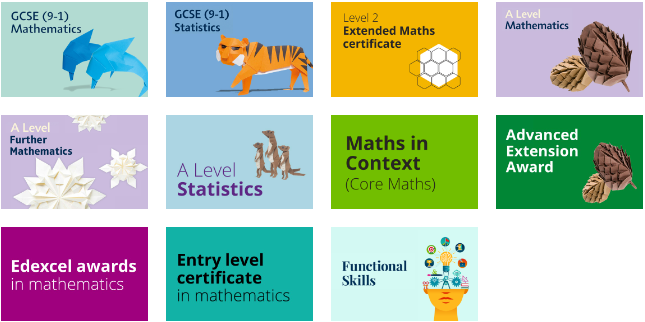
Ensure all A Level Maths and Further Maths teachers know how to access and use the digital resources and SolutionBank
✓ Make the most of Pearson professional development
Pearson offers an extensive programme of live and recorded professional development throughout the year, including:
- Exam Insights and Marking Guidance events
- Get Ready to Teach sessions
- Topic-specific training
- Professional development materials on the Maths Emporium
- Courses delivered through PD Academy
- Centre-based training (on request)
✓ Support Early Career Teachers and Non-Specialists
Provide structured support for colleagues who are new to teaching mathematics or delivering a qualification for the first time.
Ensure staff have access to:
- Enhanced Content Guidance
- Getting Started Guides
- Maths Emporium resources
- Examiner reports, mark schemes and exemplars
- Topic themed papers, check-in tests and other key lesson resources
- Subject Advisor support
- PD Academy training and recorded webinars
- SolutionBank and worked solutions to support planning and subject knowledge
✓ Stay connected to ongoing support
Encourage all staff to:
- Sign up for Subject Advisor updates
- Join our teacher networks on Facebook
- Attend relevant PD Academy events
- Access the large library of free support materials available through the Maths Emporium
Post-Series Support Timelines
We know how important it is for you to have clear, timely access to the resources and training you need. That’s why we’ve created a dedicated Post-Series Support Timeline, your go-to guide for all key dates, including when to expect materials, training sessions, and resource releases relating to the 2026 exam series.
Save time with our ready-made worked solutions for all the 2026 exams with student-friendly guidance.
Make sure you're logged into the Maths Emporium first and just use the links below to go straight to the worked solutions you need.
| Date | Qualification | Session |
| 17 September | GCSE Maths 1MA1 | Exam Insights (post 16 only) |
| 22 September | A Level Statistics 9ST0 | Practical Approaches for Effective Delivery |
| 23 September | GCSE Maths 1MA1 | Exam Insights (whole cohort) |
| 30 September | GCSE Statistics 1ST0 | Exam Insights |
| 1 October | A Level Maths 9MA0 | Exam Insights |

Curriculum reform for GCSE Maths is well underway.
The DfE have indicated that the draft new content for GCSE Maths will be published for public consultation this September.
We are hosting a series of webinars to keep teachers informed of key changes and where teachers can engage with the wider maths community to discuss their thoughts on the draft content, the possible implications for teaching and learning, ask questions and share insights.
We'll also be sharing ways that you can get involved with the public consultation and take part in our own research to inform qualification design for the new GCSE.
Sign up for updates to ensure you stay fully up to date and take part in the conversation!
The Pearson Maths Team will be at MathsConf41 in Liverpool on Saturday 5th September where I'm really looking forward to delivering a workshop on Lessons From The Data - Using National Maths Trends to Shape Teaching, Curriculum and CPD.
Our FE specialist Alice Prime will also be delivering a session on From Questions to Classroom: Tackling GCSE Maths Key Topics at Post 16
Come along and see the team, ask us questions and grab a few freebies!



12 September - International GCSE entry deadline
20 September - deadline to request modified papers
4 October - GCSE entry deadline
1 November - deadline to submit access arrangements applications
Lastly, make sure you're following us on socials to keep up to date with the latest news about our maths qualifications and services 👇
Subject advisor
Vicky Wood
Mathematics and Statistics - UK centres