September 2025 International Science Qualification News
Hello colleagues,
This update is for teachers of International GCSE and International A Level courses. Along with key dates for the term ahead it has information of a variety of upcoming training events, reminders about our exam feedback survey, news of the scientific article for IAL biology candidates in the November series, and our regular FAQs section!
I hope the start of the new term goes smoothly for you all and as ever don't hesitate to get in touch if I can help with anything.
Best wishes,
Tim Lawrence
Pearson Edexcel Subject Advisor for International Science Qualifications

| 12 September | Entry deadline for International GCSE November 2025 series |
| 25 September | Reviews of Marking and Moderation deadline |
| 17 October | Entry deadline for IAL January 2026 series |
| 12 December | Access to Scripts deadline |
A number of live online training opportunities are currently available for booking for International GCSE (IG) and International A Level (IAL) biology and physics. Some of these are free, and others cost the equivalent of 25 or 40 GBP excluding tax.
Courses for international chemistry courses will be added soon and available through the same page: Free online 'exam insights' training focusing on lessons from the June 2025 exam series will shortly be launched for all subjects too.
I have also included links (below the table of upcoming events) to the YouTube playlist for each subject where you can find recordings of past events.
View all International Science courses available and book your places
| Date | Course |
| 8 September | Getting ready to teach IG physics (modular) |
| 9 September | Getting ready to teach IG physics |
| 9 September | Getting ready to teach IG biology |
| 10 September | Understanding assessment and improving delivery in IG physics (modular) |
| 11 September | Understanding assessment and improving delivery in IG physics |
| 11 September | Getting ready to teach IG human biology |
| 15 September | Getting ready to teach IG biology (modular) |
| 15 September | Getting ready to teach IAL physics |
| 16 September | Understanding assessment and improving delivery in IAL physics |
| 18 September | Mastering marking in IAL physics |
| 23 September | Getting ready to teach IAL biology |
| 25 September | Understanding assessment and improving delivery in IG biology |
| 29 September | Understanding assessment and improving delivery in IG biology (modular) |
| 30 September | Understanding assessment and improving delivery in IAL biology |
| 13 October | Mastering marking in IAL biology |
| 21 October | Understanding assessment and improving delivery in IG human biology |
| 23 October | Mastering marking in IAL biology |
Thank you to all the teachers who have already completed our feedback surveys on the June 2025 exam series. If you haven't yet done so, the surveys are still open and we would love to hear your views.
Your feedback will play a vital role in shaping the future of our qualifications and assessments. Your input will be shared with our senior examiners and across our subject teams to help us continuously improve future assessments and enhance the exam experience for students. We really appreciate your participation in this process, thank you. Please take a few minutes to complete this survey.
Teachers can now download the pre-release scientific article for the WBI15 (Unit 5) exam (see link below). Our senior examiners have also published new guidance for teachers on the use of the article, and expectations around how they should prepare their students for questions on it.
To summarise this very briefly, teachers should help their students to understand the biology covered in the article, and this may involve covering some content not listed in the specification. Students can annotate a copy of the article and use it in their revision. They will be given a clean copy in the exam, and are not permitted to use their annotated version.

The questions below have been asked during training events recently, in our Facebook group or in emails to teachingscience@pearson.com:
Textbook authors provide one possible route through the topics of the specification, and don't necessarily follow the same order. It's important to remember that it is the specification, not the textbook, which is the key to understanding what will be assessed in exams. Examiners refer to the specification when setting exam questions, and not to textbooks. It's also important to note that you do not need to purchase Pearson textbooks to deliver our courses - you may choose resources from other publishers or to make your own.
Modular International GCSEs require some changes to the topic order compared to the linear versions. There is one set of textbooks available for both routes, so this explains some differences in the order for teachers following the modular courses. Our free schemes of work show which textbook pages are relevant to each lesson.
It is of course important that students are taught all the content for each exam before they sit it, but as long as teachers do this they are free to teach the topics in the order of their choice. For example this might involve following the order in the textbook rather than the specification or example scheme of work, if this fits with the exam schedule.
For the linear science International GCSEs the two papers assess the same topics, but paper 1 only assesses the specification points that are common to the separate biology, chemistry or physics GCSE and the Double Award science GCSE. In each subject the paper 2 assesses the whole specification.
This is because Double Award science candidates sit the same paper 1 exams - but they don't do the paper 2 exams.
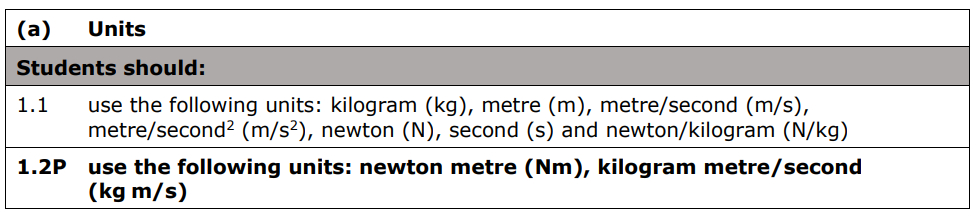
In the specification the 'additional' points which are only covered for the separate GCSE, and which are only assessed in paper 2, are in bold with a P (for physics, or a B or a C for biology and chemistry) after the numerical reference. For example see the specification points below.
The units listed in 1.1 are covered in the physics specification and in Double Award science - for physics candidates they can come up in either paper. Those listed in 1.2P only need to be covered by the GCSE physics candidates and can only come up in paper 2.
Subject advisor
Irine Muhiuddin and Tim Lawrence
UK and International Science