Geography
May 2026 Geography Subject Update
Here are the latest geography updates, bringing together key dates, training and free CPD, summer 2026 assessment materials, reminders on GCSE exam duration changes, insights from GA Conference 2026, practical GIS tools, and one to watch – the National Emergency Briefing (bring a sceptic).
This update includes:
- Key Dates
- Training for Geography teachers
- Availability of summer 2026 assessment material
- Reminder: change of duration for GCSE Geography exams from this summer
- Key insights from our time at the GA Conference 2026
- Real data. Real places. Real learning. Useful GIS tools
- One to watch (especially the sceptics) National Emergency Briefing
- Free Geography CPD this June

15 May - deadline for submitting A level coursework/NEA samples and marks to us.
15 May - Fieldwork Statements uploaded for UK Geography qualifications
13 August - Results Day for A level and International A Level
20 August - Results Day for GCSE and International GCSE

Events for UK and International GCSE and A level Geography are now available to book via our training page.
- GCSE Geography A and B: Supporting higher-attaining students - 24 June 2026 at 16:00-18:00 BST
We will be making recordings of events available for teachers who can’t attend.
You can find recorded training videos and accompanying materials for all our Exam Insights 2025 Events and Mocks Marking Events

You can find pre-recorded training videos and guidance to support the marking and delivery of A level Geography coursework on our website:

We have the following pre-recorded training events for teachers who are new to teaching our Geography specifications or are considering switching:

| Date | Activity |
|---|---|
| 23 June | GCSE & International GCSE May/June 2026 Question Papers on website |
| 30 June | AS Level, A Level & International A Level May/June 2026 Question Papers on website |
| 14 July | AS Level, A Level & International A Level May/June 2026 Mark Schemes on website |
| 21 July | GCSE & International GCSE May/June 2026 Mark Schemes on website |
| 18 August | AS/A level & IAL Examiner Reports 2026 on website |
| 25 August | GCSE & International GCSE Examiner Reports 2026 on website |

Just a reminder that there is an increase the duration of the following exam papers by 15 minutes, starting from May/June 2026:
GCSE Geography A Paper 1: 1GA0/01 - The Physical Environment - change from 1 hr 30 mins to 1 hr 45 mins
GCSE Geography B Paper 2: 1GB0/02 – UK Geographical Issues - change from 1 hr 30 mins to 1 hr 45 mins
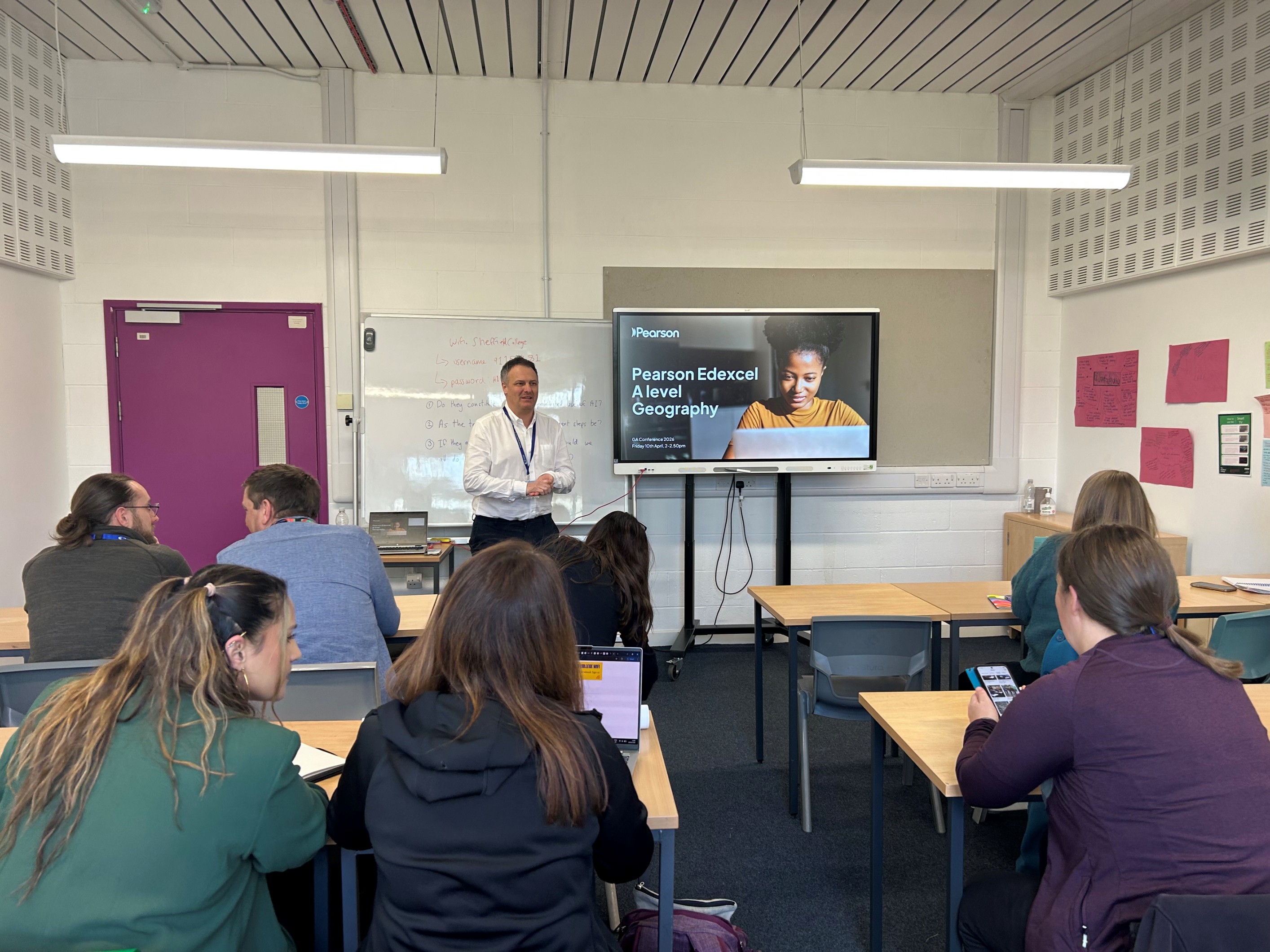
Across the two days in Sheffield, the energy was unmistakable. Through two interactive sessions and many rich conversations at the Pearson stand, teachers were open, reflective and keen to engage. That collaborative spirit shaped everything that followed and gave us a clear sense of what really matters to the teachers and their students.
What teachers told us about GCSE assessment was clear and consistent:
- Reduce content: this will lead to more meaningful assessments.
- Streamlining: A small majority favour reducing the number of GCSE Geography assessment components; the rest prefer no change.
- Fieldwork assessment: A small majority are “maybe” on continuing exam‑based fieldwork, pointing to uncertainty and appetite for a re-think.
- Better balance: Teachers most strongly supported a more even balance of knowledge, application and judgement in assessments.
- Real‑world thinking: There was a clear call for more evaluation of options and trade‑offs in genuine geographical contexts.
- Hope and relevance: Teachers want assessments that feel inclusive, hopeful and connected to issues students care about today.
Fieldwork is valued, but needing to work for more students:
- Better accessibility for students with disabilities.
- More flexibility in locations and approaches.
- Use of alternative and supplementary resources (such as video and virtual fieldwork).
- Tackling cost barriers.
- Stronger links between fieldwork, classroom learning and skill development, including GIS.

Useful GIS tools shared at the GA Conference
At the recent GA Conference session led by the GA ICT Working Group, one message came through loud and clear: if Geography is about understanding real places, then our data needs to be real, reliable and up to date too.
This closely reflects the thinking emerging from the Curriculum and Assessment Review (CAR). The review notes that some responses highlighted the absence of AI and real‑world applications while also making clear that the current curriculum does not preclude teachers from integrating up‑to‑date developments into their teaching. In Geography, this is already happening through the use of live GIS and real‑world datasets, without needing curriculum change. AI‑generated datasets can be opaque or unreliable. Geography teachers need tools they can trust and that they can access easily.
The good news? There are already plenty of free, classroom‑ready GIS tools that do exactly this.
Practical tools teachers can use straight away.
The session shared a range of examples that bring live, authentic data into lessons:
ESRI tools – including ArcGIS.
National Geographic MapMaker – intuitive, engaging and well suited to enquiry‑based learning.
ONS deprivation data, including IMD 2025, allowing students to explore inequality using current national datasets.
Local Insight – powerful for analysing local place profiles and change over time
Geomapper 2D and Geomapper 3D – helping students move between flat maps and spatial thinking in three dimensions.
Seismic Explorer - ideal for visualising hazards, tectonics and dynamic processes.
The The National Emergency Briefing is well worth seeing - screenings are being shown around the country over the next few months. It cuts through noise, slows things down and creates space for evidence‑based discussion - rather than simple soundbites - exactly what good geography is about. This is good to go for teachers, and even better as a shared experience for students. Encourage them to attend a screening if you can. And bring a sceptic (maybe a parent/carer?) The format invites questioning, challenge and debate, making it a powerful springboard for thinking about complexity, trade‑offs and real‑world decision making. In short: thoughtful, highly relevant and usable in Edexcel A level Geography and for conversations in and beyond the classroom.

Two brilliant, teacher‑free geography conferences are taking place this June – perfect for updating subject knowledge, classroom practice and fieldwork ideas.
Geography Southwest Conference
Monday 22 June 2026 | UWE Bristol
A well‑established event with keynote lectures, practical workshops and a full exhibition.
Geography Southeast Conference (NEW)
Monday 29 June 2026 - Royal Holloway University of London
Launching for the first time, following the successful SW model – again free for teachers.
Both conferences feature keynotes, workshops, GIS, fieldwork, curriculum and cutting‑edge geography, with speakers from universities, the GA, RGS‑IBG and more.
Subject advisor
Jon Wolton
Geography

Subject updates
-
June 2026 Geography Subject Update
Key dates for exam materials and insights and feedback for 2026 dates, alongside “Geography in the News” resources, and new opportunities to deepen students’ real-world understanding from ageing populations to cutting‑edge geospatial enquiry.