The Curriculum and Assessment Review: key insights and next steps for History teachers
In early November 2025, the independent Curriculum and Assessment Review (CAR) Final Report and the government’s response were released. This update, for Secondary History teachers, highlights the key points from the CAR report and the government’s response, helping you stay informed and prepared for what’s ahead.
The introduction of the EBacc performance measure in 2010 coincided with a significant rise in GCSE History entries – from around 215,000 to over 300,000 students each year more recently. However, this growth has not led to increased uptake at A level, with entries falling from a 2015 peak of 56,000 to about 45,000 now. Furthermore, the CAR report highlights that the EBacc has constrained subject choice for many students, limiting their ability to pursue arts, vocational, and technical subjects, and recommends removing the EBacc performance measure and associated headline accountability measures.
The removal of the EBacc measure presents an opportunity to broaden subject choice and create a more balanced curriculum. While this change could potentially influence GCSE History entry patterns over time, our research shows that students consistently choose History because they find it engaging, meaningful, and relevant to their lives. By continuing to design GCSE specifications that inspire curiosity and connect with diverse learners, we can ensure History remains a subject that young people actively value and choose.
Many History teachers have expressed concerns about the level of prescribed content in GCSE History, and the CAR report acknowledges this by recommending a review of subject content at reform. The report recommends a review of the content requirements within each component, which could identify where content could be streamlined. We believe that reducing the number of separate components – while preserving the integrity of each area of study – could be the most effective way to ease the content burden, allow deeper exploration of topics, and help reduce exam stress for learners. We’re pleased this issue has been recognised in the review and look forward to representing your views throughout the reform process.
We believe current GCSE History qualifications offer limited opportunities to explore the rich diversity of modern Britain, with the subject conditions restricting opportunities to study modern British history in depth.
We welcome a review of the aims behind the GCSE subject conditions in order to permit a wider range of perspectives in British History: specifically, reconsidering the way ‘British’ and ‘World’ history are defined, in order to permit a more inclusive approach.
The review recommends that the government update the programme of study to ‘promote greater diversity and, where appropriate, include local history to help students engage more deeply with their local contexts’.
Teachers report positively about the impact of teaching local history at KS2 and KS3. GCSE local history options were available in the past from Pearson Edexcel, and were assessed through coursework or controlled assessment. Current GCSE History specifications require students to study a historic environment focusing on a particular site in its historical context, examining the relationship between the place and historical events and developments.
This study, which is assessed by exam, can link to any part of the course and does not need to be local to students. We have received positive feedback from teachers for how we have nested a fixed historic environment within the thematic study in our current specification.
We look forward to representing your views throughout the reform process.
In our submission to the CAR consultation, we called for a reduction in assessment complexity and consequently the overall assessment burden.
We welcome the review’s recommendation ‘to reduce examination time by on average 2.5-3 hours overall for the average student taking eight or nine GCSEs’. For History, we believe that reducing the number of separate components is key to managing the assessment burden. A review of the assessment requirements is also needed to ensure they are more straightforward. Unlike A level History, where the assessment requirements are relatively straightforward, the GCSE subject conditions require too many different question types, which places a great burden on teachers and students to prepare and practise for exams.
Our goal is to create a more accessible, streamlined assessment model that improves the exam experience for all learners. We look forward to working with Ofqual and other awarding organisations to make this happen.
The CAR report highlights the value of media literacy in ‘engaging critically with the messages conveyed through different media channels’ and protecting against misinformation.
The report recognises the role that History plays in ‘developing the critical analysis which underpins media literacy’. Students do this by learning to analyse sources, taking into account factors such as ‘bias, reliability, perspective, and potential inaccuracies’. We welcome this recognition of the wider relevance and importance of History beyond the historical knowledge and understanding that students acquire.
Timeline for reform
The government’s response to the CAR report contains the following timeline for future reform:
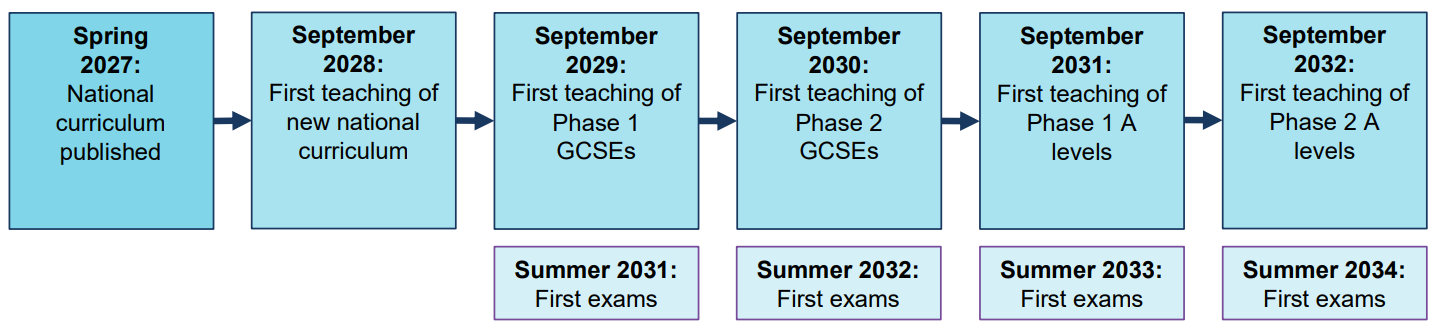
Once it's confirmed which phases GCSE and A level History fall into for redevelopment, we'll share this with you.
Next steps
We’re dedicated to continually enhancing our History qualifications, ensuring they remain inspiring, relevant, and of the highest quality for every learner. We look forward to continuing to engage with teachers, learners and other organisations to make this a reality. We’ll keep you updated with next steps via our website and let you know about opportunities to get involved and share your views.

Subject advisor
Mark Battye
History