March 2026 Politics subject update
This update contains useful information, news and advice for Edexcel Politics teachers including a new FT for Schools case study on Global Power and our new official Pearson Edexcel Politics Teachers Facebook group.
Key Dates

You can find the Summer 2026 exam timetable below:

Training for Politics teachers

Recordings of the A level Politics Summer 2025 insights event and the Paper 3 Network event, which ran in early February, will be available on our qualification page soon.
We have the following recorded training events for teachers who are new to teaching our Politics specification or are considering switching:
 Edexcel A Level Politics network event – building exam skills
( 57:42 )
Pearson Edexcel A Level Politics Exam Insights May/June 2024
( 1:28:16 )
Edexcel A level Politics Core and Non-Core Political Ideas network event
( 1:26:47 )
A Level Politics: New to Pearson Edexcel
( 1:55:51 )
Edexcel A Level Politics network event – building exam skills
( 57:42 )
Pearson Edexcel A Level Politics Exam Insights May/June 2024
( 1:28:16 )
Edexcel A level Politics Core and Non-Core Political Ideas network event
( 1:26:47 )
A Level Politics: New to Pearson Edexcel
( 1:55:51 )
Youtube Video Title
Youtube video contentRelated Videos
Edexcel A Level Politics network event – building exam skills
( 57:42 )
Pearson Edexcel A Level Politics Exam Insights May/June 2024
( 1:28:16 )
Edexcel A level Politics Core and Non-Core Political Ideas network event
( 1:26:47 )
A Level Politics: New to Pearson Edexcel
( 1:55:51 )
Resources and support materials


New FT for Schools case study - Global Politics: a multipolar world order?
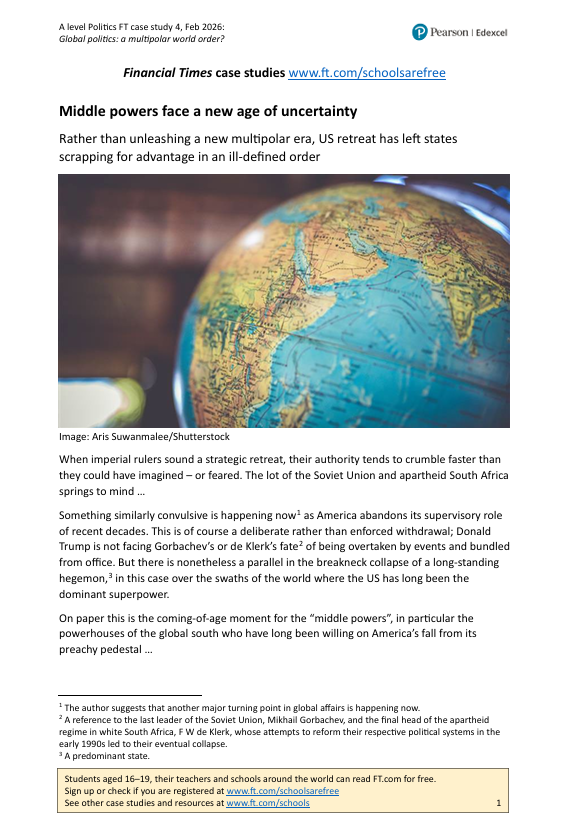
We’ve created a brand-new case study on ‘Global Politics: a multipolar world order?’, using the Financial Times for Schools resource.
This case study, based on an FT article, Middle powers face a new age of uncertainty, relates to the following Global Politics specification points:
4. Power and developments
- 4.1 Different types of power
- 4.2 Differing significance of states in global affairs and how and why state power is classified
- 4.3 Polarity
It contains research activities, discussion points, suggested homework exercises and sample student responses.
Look out for more FT for Schools case studies which will be made available soon! We’re planning to release one on the House of Lords and one on the US Supreme Court before the Summer.
A level Politics FT Case Studies: Teacher Feedback Survey
We’d love to get your feedback on this series of FT Case Studies which we launched last Autumn. Please spend a couple of minutes to tell us if you find them useful and also suggest topics for future case studies.
FAQs on General Elections and Prime Minister case studies
Ahead of this summer’s exams we’ve been receiving some questions from teachers about the specification requirement for students to know about case studies of different general elections and Prime Ministers. The following FAQs aim to clarify the rationale for this requirement and how it relates to questions in the exam.
The specification states that, for Paper 1 UK Politics section 4, teachers should cover: case studies of three elections (one from the period 1945–92, the 1997 election, and one since 1997), the results and their impact on parties and government. This requirement comes directly from the DfE content requirements for A level Politics which our specification must meet. Students must therefore be taught this content, and we’d suggest that this is a minimum, since students should ideally be learning about more than one general election since 1997 in order to keep the course up-to-date and relevant. Since the DfE subject content was first published in 2016, a further three general elections have taken place. The rules from the DfE effectively mean that only one general election – that of 1997 – can be named in an examination question, e.g., Summer 2023 Q1a.
This very much depends on the question set.
In Summer 2025 Paper 1, Question 2b asked students to ‘Evaluate the view, with reference to at least three general elections, that social class and region have very little impact on voting behaviour.’
Since this question does not refer to any specific elections, students were free to use any elections they wished, although where they did not include at least one recent election this ran the risk of their analysis not being up-to-date. This question was answered by 62% of students, and the average mark was in line with that for essay questions in recent series. There is further feedback on this question in the examiners report:
It’s also possible that a future question could specifically require students to provide examples from the periods listed (1945-92, 1997, post-97), as that would be within the remit of the specification. As teachers, you should advise your students they must be aware of the requirement to know about general elections from the specified periods, and they can then use those in questions where appropriate. Students must therefore read the question carefully before responding.
The specification states that, for Paper 2 UK Government section 3, teachers should cover case studies of: the influence of one Prime Minister from 1945-1997 and one post-1997 Prime Minister. As with the elections requirement discussed above, this comes directly from the DfE content requirements for A level Politics which our specification must meet. Students must therefore be taught this content, and we’d suggest that this is a minimum, since students should ideally be learning about more than one Prime Minister since 1997 in order to keep the course up-to-date and relevant. Since the DfE subject content was first published in 2016, there have been a further five PMs.
This very much depends on the question set and students should be encouraged to read the question carefully.
In Summer 2025 Paper 2, Question 2b asked students to ‘Evaluate the view that Prime Ministers now have too much power.’
This question did not specifically require students to consider one Prime Minister from 1945-1997, however it did require students to analyse by using more historical PMs to generate a sense of change over time, and that is clearly an area students should be prepared for if they have been taught the required case studies. With this question, because it did not give a time frame, students could interpret ‘now’ in different ways: some chose to contrast a post-1997 PM with a pre-1997 PM; others compared a very recent PM (like Starmer) with another post-1997 PM (like Blair). As we have noted generally in previous summer insights events, we encourage the usage of contemporary examples by students to support their arguments. Many students answered this question using Starmer effectively, comparing his power with historical predecessors in Number 10 to generate a sense of change over time and thus address the use of the word ‘now’ in the question. The indicative content in the mark scheme provides examples of PMs from Wilson through to Starmer. This question was answered by 72% of students, and the average mark above that for essay questions in recent series.
There is further advice on this question in the examiner’s report:
It’s important to understand that politics is a contemporary subject as opposed to purely a historical one. On this basis we reward responses that use both historical and contemporary information if the question allows this. If we require specific time periods for Prime Ministers, then the question will ask for this (as per the specification requirements).
Subject advisor
Mark Battye
Government and Politics