January 2026 International Science Qualification News
Hello colleagues,
Welcome to your January update for teachers of International Science qualifications! We have a news of a range of training events for chemistry teachers this month, as well as a university admissions webinar aimed at teachers in international centres preparing students for applications to leading global universities. I also recommend reading my colleague Irine's general 'Teaching Science' update (link below).
As ever, don't hesitate to get in touch if I can help in any way - why not book a Teams call with me (follow the link below) if it would be helpful to talk something over?
Best wishes,
Tim Lawrence
Pearson Edexcel Subject Advisor for International Science Qualifications

| 21 January | University Applications Webinar for IAL science teachers |
| 21 January | IG and IAL results from October/November series to centres |
| 22 January | IG and IAL results from October/November series to candidates |
We have a number of live online training events coming up in January, February and March for International GCSE Chemistry and for IAL Chemistry. See below for dates and times and for a link to register for these events, and to find others in the future.
I have also included links (below the table of upcoming events) to the YouTube playlist for each subject where you can find recordings of past events.
View all International Science courses available and book your places
All the events below start at 9.00 UK time.
| Date | Course |
13 January |
Understanding Assessment & Improving Delivery in International GCSE Chemistry |
15 January |
Understanding Assessment & Improving Delivery in International A Level Chemistry |
3 February |
International GCSE Chemistry, Enhancing Teaching through Exam Insights |
5 February |
International A Level Chemistry, Enhancing Teaching through Exam Insights |
24 March |
Mastering Marking in International GCSE Chemistry |
Teachers will be able to download the pre-release scientific article for WBI15 (the Unit 5 exam) for January before the end of November (the date will be close to the 20th November). Our senior examiners have also published new guidance for teachers on the use of the article, and expectations around how they should prepare their students for questions on it.
To summarise this very briefly, teachers should help their students to understand the biology covered in the article, and this may involve covering some content not listed in the specification. Students can annotate a copy of the article and use it in their revision. They will be given a clean copy in the exam, and are not permitted to use their annotated version.

Teachers, students and parents often have questions about the suitability of specific qualifications for applications to top universities. We shared some good news regarding Edexcel International A Levels in my November update (see below).
On Wednesday 21 January, at 8.30am UK time, we are holding a webinar titled Unlock STEM Success: Insights from Oxford & top universities. This free event is designed for teachers in international centres, to help them better advise their students who aspire to pursue STEM degrees at leading global universities. James Riley, International Student Recruitment Officer at the University of Oxford, and Kate Andrina, International Student Recruitment Assistant at the University of Oxford, will join myself and Jonathan Wong, Pearson International Sciences Partner, to discuss what top universities really look for and how to build strong foundations for STEM using Pearson Edexcel IAL sciences. See below for a link to more information and registration.
Oxford, Cambridge, UCL, and Imperial have confirmed that their practical endorsement requirement only applies to UK A Level applicants. They’ve also made it clear that:
- They don’t favour one awarding body (exam board) over another
- They accept Edexcel IALs with their written practical skills assessment
- They welcome both UK and International A Level qualifications equally
So, students and parents can feel confident - Edexcel IALs meet the entry requirements for even the most competitive science, medicine and engineering courses.
Ofqual has launched a consultation on proposals for how on-screen assessment should be regulated in GCSEs, AS and A levels in England. Whilst they propose a controlled introduction of on-screen assessment, pen-and-paper will remain central to most exams.
International GCSEs and A Levels are not regulated by Ofqual, but Pearson's approach to assessment of these courses is heavily influenced by the approach adopted for UK qualifications.
As teachers working directly with students, you understand their needs and the challenges this proposal may present.
Your opinion counts. The consultation closes on 5 March 2026. Please take a look and have your say.
The questions below have been asked during training events recently, in our Facebook group or in emails to teachingscience@pearson.com:
We have recently published an article on our Support Portal addressing this, since students, parents and teachers often have related questions. For example, on how Double Award science compares to biology, chemistry and physics and how grading works for this course, and how the modular versions of these qualifications relate to the linear versions. It may be helpful to share the page linked below with parents if they have questions.
We have recently published an article on our Support Portal addressing questions around practical science requirements and how practical work is assessed, for International A Level and International GCSE courses. There are key differences between how this works for Edexcel International science courses compared to the equivalent UK qualifications and compared to International qualifications from other awarding organisations. It may be helpful to share the page linked below with parents and/or students.
Yes this is something that International GCSE chemistry and physics candidates should prepare for for future exams. It's listed in Appendix 4 of the specification - for example mathematical skills on p.43: International GCSE Chemistry 2017 Specification
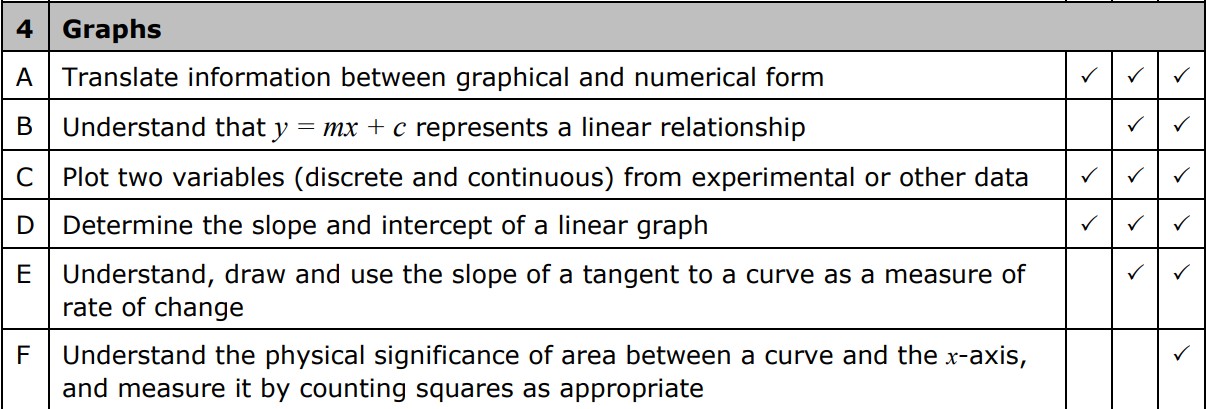
Point 4E reads "Understand, draw and use the slope of a tangent to a curve as a measure of rate of change" - this can be assessed in IG chemistry and physics (but not biology). It's worth having a look through this list and incorporating some questions into lessons to help students practice these skills in a chemistry context. They should be familiar with all of the points from their GCSE maths studies by the time they get to the end of the course, but can struggle to 'transfer' their skills when they come across them in science.
Below is part of appendix 4 showing which graph-related skills can be assessed in each science subject at International GCSE.
To answer briefly, bullet points are not recommended for those extended response questions marked with an asterisk, as they encourage responses that are too 'list like'. If bullets are used to separate full sentences, and these are well linked so that they could have been presented as a continuous prose paragraph, then this is no problem and may help a student to structure their answer. However our standard advice is to answer as a continuous paragraph.
Here's some more detailed guidance for students:
The asterisk signals that marks will be awarded for the quality of your written communication (QWC). This means the examiner is not only looking for correct science content but also assessing:
- Logical structure – Your answer should flow in a clear, organised way, showing how points link together.
- Clarity and coherence – Ideas should be connected with reasoning, not just listed.
- Spelling, punctuation, and grammar – These must be accurate.
- Use of appropriate scientific terminology – For example, terms like activation energy, enthalpy change, oxidising agent, etc.
Essentially, these questions test your ability to explain or evaluate in extended prose, not just recall facts. They often appear as 6-mark or higher extended-response questions.
How to Approach These Questions:
- Plan before writing. Spend 20–30 seconds jotting down key points in order. This helps you avoid missing marks.
- Follow a logical sequence. Link ideas using phrases like therefore, as a result, because.
- Cover all required aspects. Break the question into sub-parts and address each one.
- Use correct terminology. Avoid vague phrases like “it reacts more”; instead, use precise terms such as electron pair repulsion or oxidation state.
- Write in full sentences. Bullet points rarely score well for QWC marks.
Subject advisor
Irine Muhiuddin and Tim Lawrence
UK and International Science